
Strategy
is a behavioral design pattern that lets you define a family of algorithms, put each of them into a separate class, and make their objects interchangeable.

Problem
One day you decided to create a navigation app for casual travelers. The app was centered around a beautiful map which helped users quickly orient themselves in any city.
One of the most requested features for the app was automatic route planning. A user should be able to enter an address and see the fastest route to that destination displayed on the map.
The first version of the app could only build the routes over roads. People who traveled by car were bursting with joy. But apparently, not everybody likes to drive on their vacation. So with the next update, you added an option to build walking routes. Right after that, you added another option to let people use public transport in their routes.
However, that was only the beginning. Later you planned to add route building for cyclists. And even later, another option for building routes through all of a city’s tourist attractions.
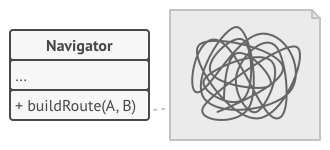
The code of the navigator became bloated.
While from a business perspective the app was a success, the technical part caused you many headaches. Each time you added a new routing algorithm, the main class of the navigator doubled in size. At some point, the beast became too hard to maintain.
Any change to one of the algorithms, whether it was a simple bug fix or a slight adjustment of the street score, affected the whole class, increasing the chance of creating an error in already-working code.
In addition, teamwork became inefficient. Your teammates, who had been hired right after the successful release, complain that they spend too much time resolving merge conflicts. Implementing a new feature requires you to change the same huge class, conflicting with the code produced by other people.
Solution
The Strategy pattern suggests that you take a class that does something specific in a lot of different ways and extract all of these algorithms into separate classes called strategies.
The original class, called context, must have a field for storing a reference to one of the strategies. The context delegates the work to a linked strategy object instead of executing it on its own.
The context isn’t responsible for selecting an appropriate algorithm for the job. Instead, the client passes the desired strategy to the context. In fact, the context doesn’t know much about strategies. It works with all strategies through the same generic interface, which only exposes a single method for triggering the algorithm encapsulated within the selected strategy.
This way the context becomes independent of concrete strategies, so you can add new algorithms or modify existing ones without changing the code of the context or other strategies.
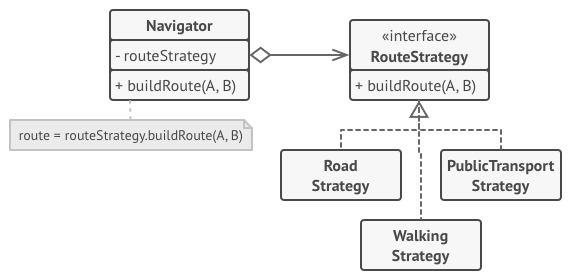
Route planning strategies.
In our navigation app, each routing algorithm can be extracted to its own class with a single buildRoute method. The method accepts an origin and destination and returns a collection of the route’s checkpoints.
Even though given the same arguments, each routing class might build a different route, the main navigator class doesn’t really care which algorithm is selected since its primary job is to render a set of checkpoints on the map. The class has a method for switching the active routing strategy, so its clients, such as the buttons in the user interface, can replace the currently selected routing behavior with another one.
Real-World Analogy

Imagine that you have to get to the airport. You can catch a bus, order a cab, or get on your bicycle. These are your transportation strategies. You can pick one depending on factors such as budget or time constraints.
Structure
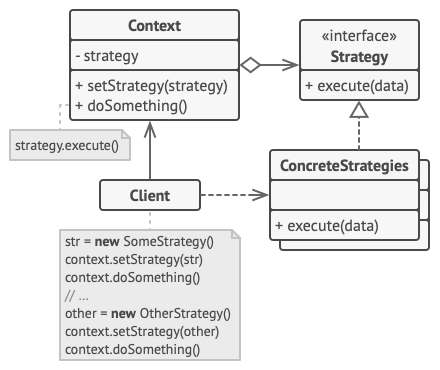
- The Context maintains a reference to one of the concrete strategies and communicates with it via the strategy interface.
- The Strategy interface is common to all strategies and declares the execution method used by the context.
- Concrete Strategies implement various versions of the algorithm the context uses.
- The Context invokes the strategy each time it needs to perform the algorithm, without knowing the exact strategy type.
- The Client creates a specific strategy and passes it to the context, allowing runtime replacement of strategies.
C++ implementation
/**
 * The Strategy interface declares operations common to all supported versions
 * of some algorithm.
 *
 * The Context uses this interface to call the algorithm defined by Concrete
 * Strategies.
 */
class Strategy
{
public:
    virtual ~Strategy() = default;
    virtual std::string doAlgorithm(std::string_view data) const = 0;
};

/**
 * The Context defines the interface of interest to clients.
 */

class Context
{
    /**
     * @var Strategy The Context maintains a reference to one of the Strategy
     * objects. The Context does not know the concrete class of a strategy. It
     * should work with all strategies via the Strategy interface.
     */
private:
    std::unique_ptr strategy_;
    /**
     * Usually, the Context accepts a strategy through the constructor, but also
     * provides a setter to change it at runtime.
     */
public:
    explicit Context(std::unique_ptr &&strategy = {}) : strategy_(std::move(strategy))
    {
    }
    /**
     * Usually, the Context allows replacing a Strategy object at runtime.
     */
    void set_strategy(std::unique_ptr &&strategy)
    {
        strategy_ = std::move(strategy);
    }
    /**
     * The Context delegates some work to the Strategy object instead of
     * implementing +multiple versions of the algorithm on its own.
     */
    void doSomeBusinessLogic() const
    {
        if (strategy_) {
            std::cout << "Context: Sorting data using the strategy (not sure how it'll do it)\n";
            std::string result = strategy_->doAlgorithm("aecbd");
            std::cout << result << "\n";
        } else {
            std::cout << "Context: Strategy isn't set\n";
        }
    }
};

/**
 * Concrete Strategies implement the algorithm while following the base Strategy
 * interface. The interface makes them interchangeable in the Context.
 */
class ConcreteStrategyA : public Strategy
{
public:
    std::string doAlgorithm(std::string_view data) const override
    {
        std::string result(data);
        std::sort(std::begin(result), std::end(result));

        return result;
    }
};
class ConcreteStrategyB : public Strategy
{
    std::string doAlgorithm(std::string_view data) const override
    {
        std::string result(data);
        std::sort(std::begin(result), std::end(result), std::greater<>());

        return result;
    }
};
/**
 * The client code picks a concrete strategy and passes it to the context. The
 * client should be aware of the differences between strategies in order to make
 * the right choice.
 */

void clientCode()
{
    Context context(std::make_unique());
    std::cout << "Client: Strategy is set to normal sorting.\n";
    context.doSomeBusinessLogic();
    std::cout << "\n";
    std::cout << "Client: Strategy is set to reverse sorting.\n";
    context.set_strategy(std::make_unique());
    context.doSomeBusinessLogic();
}

int main()
{
    clientCode();
    return 0;
}
Applicability
Use the Strategy pattern when you want to use different variants of an algorithm within an object and switch during runtime.
The Strategy pattern lets you change the object’s behavior at runtime by linking different sub-objects that perform sub-tasks differently.
Use the Strategy when many similar classes differ only in the way they execute some behavior.
The Strategy pattern extracts the varying behavior into a separate hierarchy and merges duplicate classes, reducing repetition.
Use the pattern to isolate business logic from implementation details of algorithms.
The Strategy pattern isolates algorithm dependencies and data from the rest of the system, exposing a simple interface to execute and swap algorithms.
Use the pattern when your class has large conditional statements that switch between variants of the same algorithm.
Strategy eliminates these conditionals by extracting algorithms into separate classes implementing a shared interface.
⚖️ Pros & Cons
- You can swap algorithms used inside an object at runtime.
- You can isolate the implementation details of an algorithm from the code that uses it.
- You can replace inheritance with composition.
- Open/Closed Principle. You can introduce new strategies without having to change the context.
- If you only have a couple of algorithms and they rarely change, there’s no real reason to overcomplicate the program with new classes and interfaces that come along with the pattern.
- Clients must be aware of the differences between strategies to be able to select a proper one.
- A lot of modern programming languages have functional type support that lets you implement different versions of an algorithm inside a set of anonymous functions. Then you could use these functions exactly as you’d have used the strategy objects, but without bloating your code with extra classes and interfaces
Relations with Other Patterns
- Bridge, State, Strategy, and Adapter share similar structures based on composition (delegating work to other objects) — but each solves a distinct problem.
-
Command and Strategy look alike because both parameterize objects with actions,
but their intents differ:
- Command turns any operation into an object, allowing deferred execution, queuing, history tracking, and remote invocation.
- Strategy describes multiple possible ways to perform an operation, enabling runtime swapping of algorithms.
- Decorator changes an object’s “skin”, while Strategy changes its “guts”.
- Template Method (inheritance-based) alters parts of an algorithm at the class level, while Strategy (composition-based) switches behavior at the object level, dynamically at runtime.
- State extends Strategy: both change context behavior via delegation, but State allows linked states to modify one another and the context itself.